
Dispatch, Maintenance, Cabin, Cockpit: Staffing a Flight Department With One Partner

Count the staffing relationships it takes to keep your operation covered. For a lot of flight departments, the number is four or five. A contract pilot service. A cabin attendant agency. A maintenance staffing firm the DOM found somewhere. A dispatch or scheduling contractor. And a generalist recruiter HR already had on the approved vendor list who has never filled a type-rated seat in their life.
Every one of them has its own MSA, its own insurance certificate, its own onboarding packet, its own invoice cycle, and its own private definition of the word vetted. None of them talk to each other. So, when the Falcon needs a captain, a cabin attendant, and an A&P at the same FBO on the same Tuesday, you are the integration layer.
That is the real cost, and it rarely shows up on any invoice. It is not that any single vendor is bad. It is that the coordination lands on the person who is already handling scheduling, compliance, training records, and every other vendor decision in the department.
The Gap Was Never Only A Pilot Gap
Boeing's 2026 Pilot and Technician Outlook projects North America will need 122,000 new pilots over the next 20 years. It also projects 125,000 maintenance technicians and 191,000 cabin crew members over the same period. Maintenance and cabin both outrank the cockpit, and about two thirds of that total demand comes from retirement and attrition rather than fleet growth.
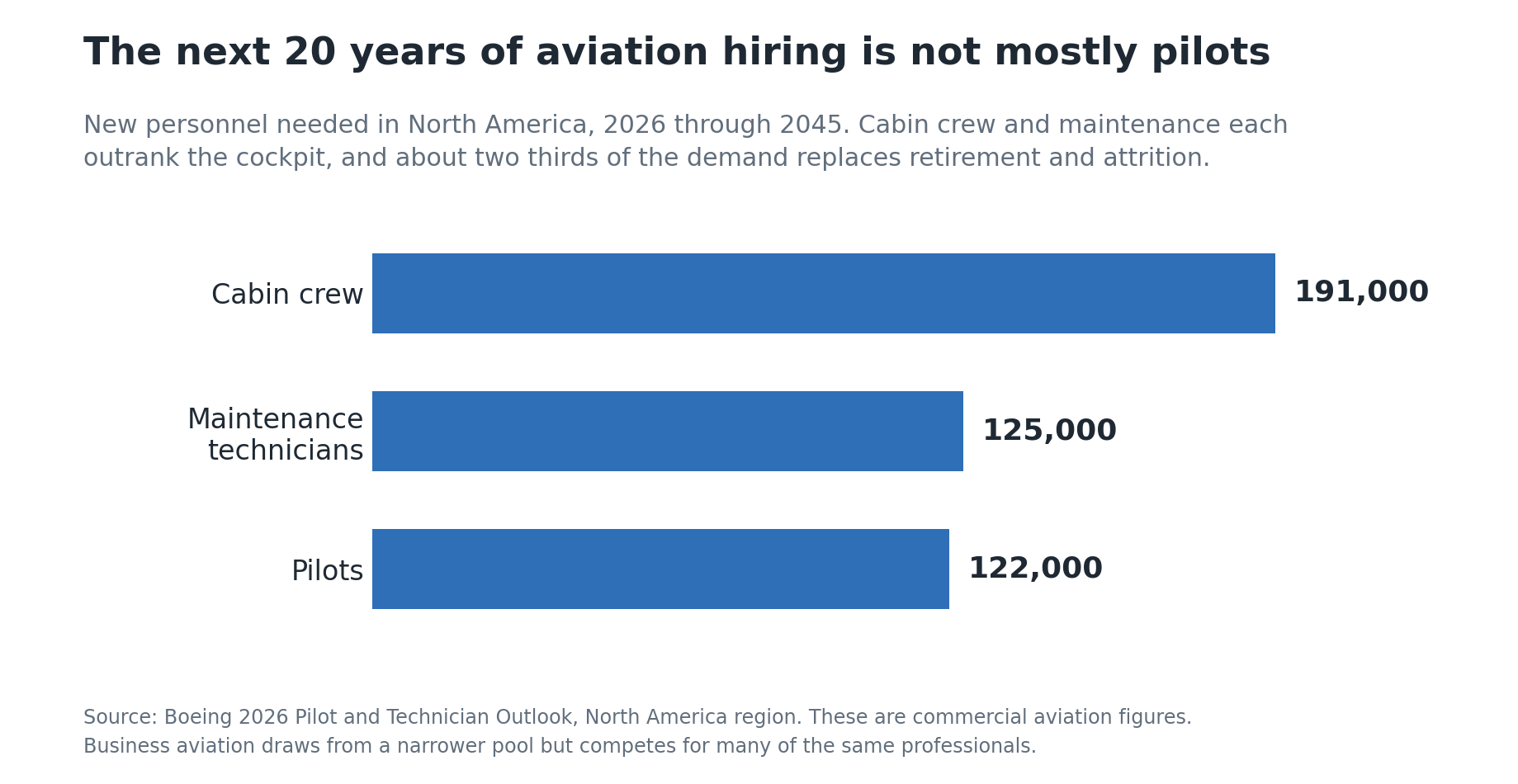
Those are commercial aviation figures, and business aviation draws from a narrower pool with different qualification requirements. We are not going to pretend the numbers transfer one for one. But the shape of the problem is the same one our clients describe, and the two industries compete for many of the same people.
On the maintenance side the numbers are tighter than most operators realize. The Aviation Technician Education Council counts a US civil aviation maintenance workforce of more than 431,000. The FAA issued roughly 9,000 new mechanic certificates in 2024, the second largest year over year increase on record. ATEC still projects a 10 percent shortage of certified mechanics, narrowing to 7 percent by 2035, which at that point still leaves us about 10,000 mechanics short of what commercial passenger and cargo flying alone requires. Business and general aviation demand sits on top of that number, not inside it.
Business aviation already sees this. When NBAA's National Safety Forum polled operators on which roles workforce shortages hit hardest, 53 percent said pilots and 35 percent said maintenance. We track the same pattern in our own State of the Aviation Industry report.

The more useful line in that same poll is what operators are doing about it. Sixteen percent are outsourcing operations and 9 percent are bringing on temporary staff. A quarter of the room is already answering a workforce problem with outside labor. The question is no longer whether to use an outside partner. It is how many of them you want to manage.
Cockpit
A type rating is where the screening starts, not where it ends. We verify time in type rather than time on the badge, date and location of last recurrent, oceanic and international currency where the trip calls for it, duty and rest planning on long legs, and whether the candidate clears the minimums written in your insurance policy rather than a generic industry number.
Contract pilots placed through IFCC are our W-2 employees. We carry background screening, drug testing, FAA records and currency verification, workers' compensation, global medical and repatriation coverage, and state employment compliance before anyone reaches your aircraft. There is no 1099 arrangement, so misclassification exposure never lands on your operation. When the seat is permanently open, our direct hire team can source from a passive candidate database of professionals who are not on job boards and not answering postings in addition to candidates who may be actively looking. If you want to see what we have typed on your airframe, our Pilot Locator is organized by aircraft.
Cabin
Corporate cabin attendants are the role most often handled by a separate vendor, and the one where a bad placement is most visible to the person who owns the aircraft. Airline experience is not the qualification. Corporate service, safety training current and documented, food handling, comfort in a principal's environment, and discretion are.
We place cabin attendants on the same W-2 terms as pilots, screened and insured before the trip, on the same trip request that covers the cockpit. One call, one crew.
Maintenance
This is the bucket most flight departments do not think of as a staffing category until a technician gives notice in the middle of an inspection cycle. A&P mechanics, avionics technicians, and maintenance controllers are harder to source than pilots in a lot of markets, and the credentialing is different enough that a generalist firm will not know what it is looking at.
Contract maintenance coverage carries the same compliance package as contract crew. Certificate verification, background screening, drug and alcohol program compliance, workers' compensation, and W-2 employment. When you need a permanent DOM or lead technician, that runs through the same direct hire process as a cockpit seat.
Scheduling and Dispatch
Scheduling is where most flight departments are quietly understaffed. One person is often covering trip planning, crew scheduling, catering, hotels, permits, customs, and every vendor call in the department, and there is no backup when they take a week off.
ONeCALL Flight Dispatch is our virtual dispatch operation. Certified dispatchers, 24/7/365, working inside your existing flight management software as an extension of your team rather than a replacement for it. Some operations use it for overflow during peak season. Some use it to cover a vacancy. Some use it so their one scheduler can take a vacation without the department going dark.
We also place schedulers and dispatchers as direct hires when the seat should be permanent.
What Consolidation Actually Changes
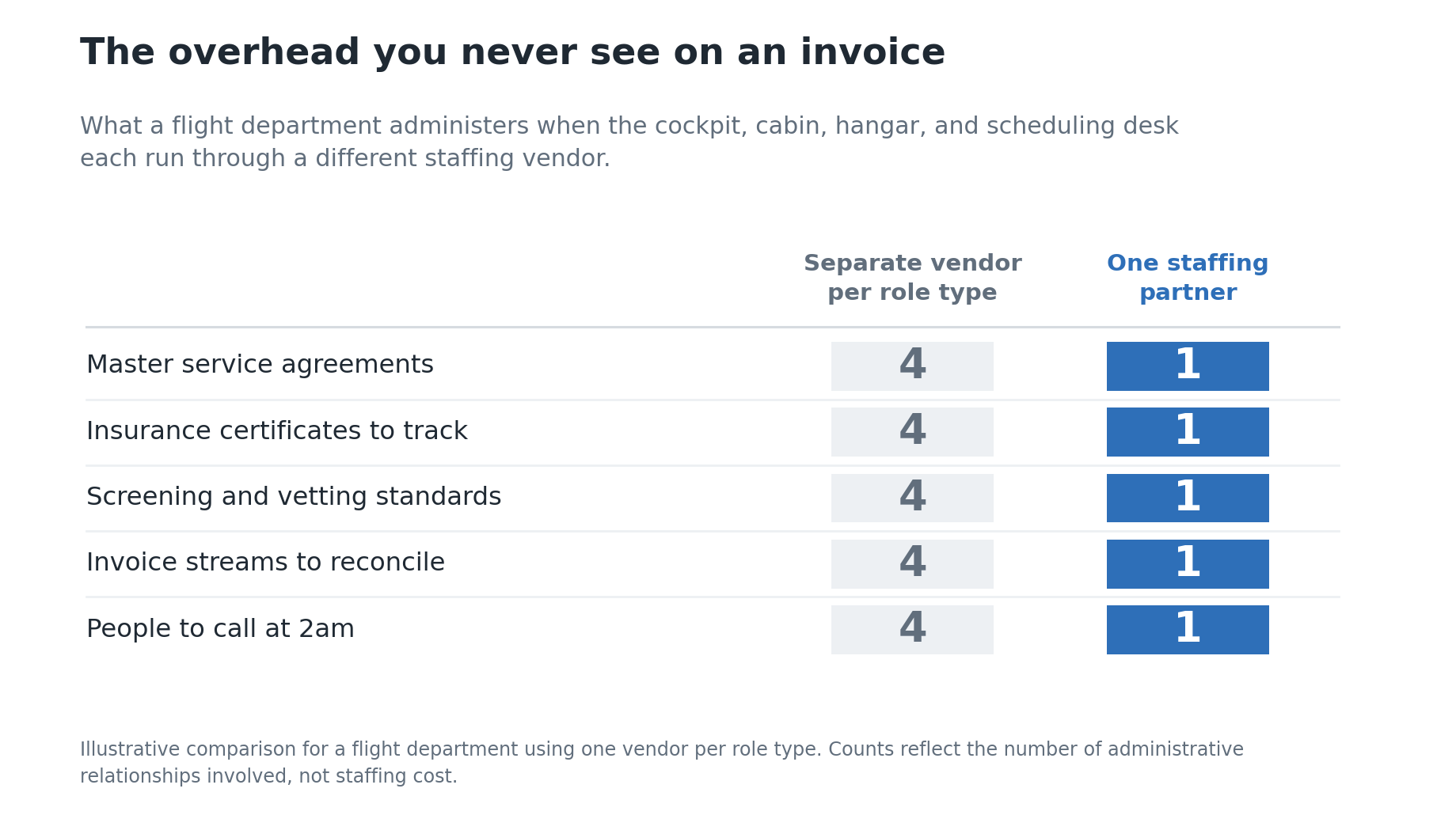
The compliance piece is the part that gets underestimated. With one W-2 employer of record across all four role types, there is one set of insurance certificates, one screening standard, and one audit trail. When your legal team asks who carries workers' compensation on the contract mechanic who was in your hangar in March, there is one answer instead of a search through four vendor files. We wrote up how the employer of record model works and the risk of misclassifying employees in this whitepaper.
Match the Engagement to the Seat, Not the Vendor
Not every gap is a hiring problem. A headcount freeze, a peak season, a training footprint, and a permanently open seat are four different situations, and they call for different arrangements.

Contract staffing covers gaps, peaks, and anything a headcount freeze will not let you hire for. Direct hire fills a seat that is open for good. HR and payroll services cover the operations that want the employment administration handled without building it in house. Dispatch runs similarly to our contract staffing services. Same relationship, same paperwork, same people answering the phone.
What To Ask Any Staffing Partner, Including Us
- Are your contract crew and technicians your W-2 employees or 1099 contractors?
- Who carries workers' compensation and international medical on the person you send to my hangar?
- How do you verify currency and credentials, and what do you check beyond the certificate itself?
- What happens at 2am when the person you sent cannot make the trip?
Vague answers on any of those mean the risk stays with you.
The Part That Matters At 5am
A flight department calls us at 11pm. A crew member is sick. The aircraft needs to be wheels up at 6am. We find someone typed, current, background screened, and drug tested, confirm duty and rest, and have them in place before the sun comes up. The client never makes a second call.
We have filled 99.7 percent of crew requests since 2002, across more than 400 flight departments, with 13 consecutive ClearlyRated Best of Staffing Awards and a 92 percent Net Promoter Score behind it. That last number is higher than Ritz-Carlton's!
None of that helps you if we are not already in place. The operators who get the most out of this relationship signed an MSA long before they had a problem. Get us on your vendor list now, so the 5am call is just a phone call and not a crisis.
Frequently Asked Questions
Can one staffing partner cover pilots, cabin attendants, maintenance technicians, and dispatchers?
Yes. In-Flight Crew Connections staffs all four role types and more for corporate flight departments and Part 135 operators, on contract and on direct hire, under a single agreement. Contract placements across every role are IFCC W-2 employees, so one employer of record covers the cockpit, the cabin, the hangar, and the scheduling desk.
What is the difference between contract crew and direct hire?
Contract crew work as IFCC W-2 employees for a defined trip or period, and we carry payroll, screening, insurance, and compliance. Direct hire is permanent placement on your payroll, where we source and fully vet the candidate before you meet them. Contract covers gaps, peak season, training footprints, and headcount freezes. Direct hire fills a seat that is permanently open.
Are IFCC contract crew and technicians 1099 contractors?
No. Every contract placement is an IFCC W-2 employee and IFCC is the employer of record. Misclassification exposure stays off your operation.
Do you staff maintenance technicians as well as pilots?
Yes. We place A&P mechanics, avionics technicians, maintenance controllers, and directors of maintenance, on contract and on direct hire, with the same certificate verification, background screening, and W-2 employment as flight crew.
Can you cover flight scheduling and dispatch?
Yes. Our ONeCALL Flight Dispatch services can provide certified virtual dispatchers 24/7/365 who work inside your existing flight management software. We also recruit schedulers and dispatchers for direct hire positions.
How fast can you fill a crew request?
We have filled same-day requests with less than eight hours’ notice, and our fill rate across 24 years is 99.7 percent. Expect direct hire searches to run about 90 days depending on the role.
How much of my flight department can IFCC actually handle?
Contract crew, direct hire recruiting across all four role types, HR and payroll administration, and virtual flight dispatch. One relationship, one compliance standard, one number to call.