
Aviation Maintenance Staffing: How to Stay Ahead of the A&P Technician Shortage

Aviation maintenance staffing has become the hardest hiring problem in business aviation, and the forecasts operators see quoted mostly leave the segment out. Finding a qualified A&P mechanic used to take a phone call or two. Now it can take a week or more of dead ends, and time is exactly what you don’t have when an aircraft is grounded. The one technician on your team qualified to make the necessary repair just went out on medical leave. The independent Part 145 repair station you used to call for a loaner mechanic can’t spare one either, because they’re short too. You start working the phones, and every call sounds the same: nobody has a spare A&P sitting around.
If that's happened to you in the last year, you haven’t mismanaged anything. You’re managing a labor market that shrank while your flight department’s workload grew.
The Shortage Is No Longer Just A Talking Point
The U.S. is short roughly 10,000 certified mechanics against commercial demand alone, and the gap does not close inside the next decade. For a few years, the aviation maintenance technician shortage was mostly a conference slide, something to plan around eventually. That’s over. The numbers now describe a gap that’s already sitting inside your hangar.
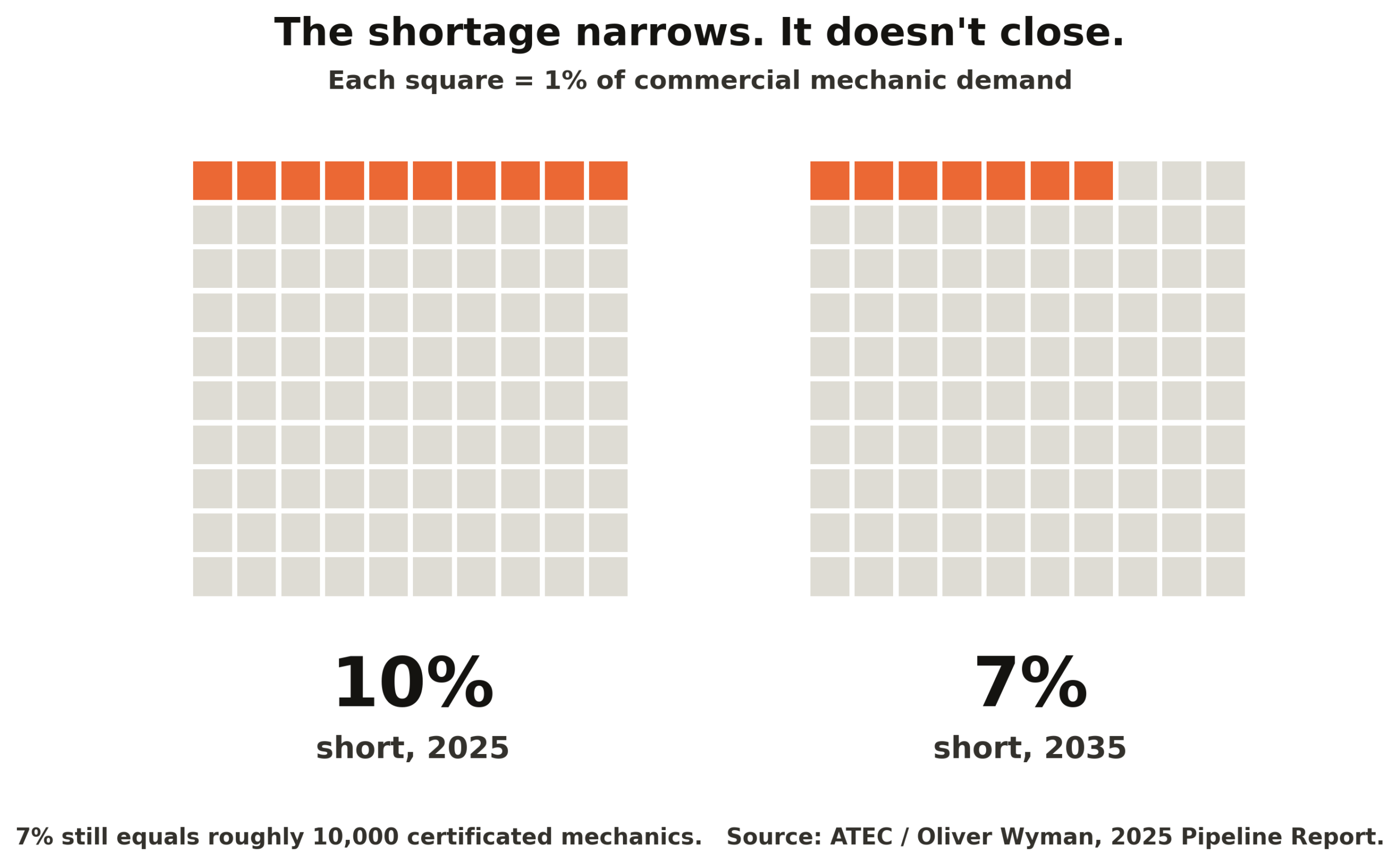
The most recent Pipeline Report from ATEC and Oliver Wyman, published in September 2025, put the U.S. civil aviation maintenance workforce at more than 431,000 people. The FAA issued roughly 9,013 new mechanic certificates in 2024, one of the strongest totals on record, and it still isn’t close to enough. Demand from commercial air transport alone is expected to outpace supply by 10% in 2025. That gap narrows over the next decade, but only to 7%, which the report translates to a shortage of roughly 10,000 certificated mechanics in 2035. And that’s before adding a single technician’s worth of demand from business and general aviation fleets.
Boeing's newest Pilot and Technician Outlook, released in 2026, projects global demand for 728,000 new maintenance technicians over the next 20 years, with 125,000 of those needed in North America alone. Both numbers are higher than what Boeing projected the year before, which tells you the gap isn’t closing on its own. The U.S. Bureau of Labor Statistics, looking only at domestic job openings, projects about 13,100 aircraft and avionics mechanic and technician positions opening every year through 2034, and most of those openings come from retirements, not growth.
Neither of those forecasts is built around business aviation specifically. Boeing’s model leaves it out entirely, and BLS folds it into a broader occupational category. CAE's 2025 Aviation Talent Forecast does break the segment out, and puts business aviation's need at 69,000 new maintenance technicians by 2034 against a fleet growing from roughly 23,000 to 27,000 aircraft. That’s worth sitting with for a second, because it means the pressure on corporate flight departments and Part 135 operators is worse than the headline numbers suggest, not better. We wrote about the roots of that gap, and what the industry can do about it long term, in Running on Empty: 4 Ways to Build a Sustainable Maintenance Workforce. This article is about what to do about it this quarter.
Why Your Flight Department Feels It Before The Airlines
ATEC puts the average age of an FAA registered mechanic at 54, and CAE projects 83% of today's technicians will retire or leave the trade within ten years. Every certificated mechanic who graduates this year has options an operator twenty years ago didn’t have to compete with. Airlines are hiring. MRO shops like Duncan Aviation and West Star Aviation are hiring. OEM's including Gulfstream, Textron Aviation, and Bombardier are hiring straight out of their own training pipelines. Even outside aviation, technicians with A&P-adjacent skills get recruited by employers who can offer a fixed schedule and a home base every night, something a lot of contract maintenance work can’t promise.
Business aviation has a structural disadvantage in that fight. A corporate flight department with two or three aircraft can’t out-hire an airline’s talent pipeline, and it usually can’t match a major MRO’s training budget either. What it can offer, when it’s run well, is variety, autonomy, and a smaller, closer team, which matters to plenty of technicians. But that pitch only works if candidates know it exists, and most flight departments aren’t set up to run their own recruiting funnel on top of everything else they’re doing.
ATEC reports that AMTS (aviation maintenance technician school) enrollment is up nationally, which is genuinely good news. But roughly a third of available training seats still go unfilled, largely because too few students know aviation maintenance is a career option, and the instructor pipeline hasn’t kept pace with the growth that is happening. In practical terms, this all means the new certificate holders entering the workforce this year won’t fully offset the wave of retirements already underway, let alone give business aviation a bigger slice of a shrinking pool.
What An Open Maintenance Seat Actually Cost You
An open maintenance seat is quieter and, in some ways, more expensive. An open pilot seat is visible immediately. A trip doesn’t happen. It shows up in ways such as deferred inspections or a technician working overtime until they burn out and leave (which turns one open seat into two).
Then there’s the AOG (aircraft on ground) scenario. When a discrepancy grounds the aircraft and nobody available holds the certificate, rating, or type experience to sign the return to service, you're not just delaying a trip. If the aircraft is away from base, you're flying a technician to it and paying for travel, lodging, and billable hours that start before anyone opens a panel. Or you're paying premium rates to a shop that knows you have no other option.
And underneath all of it sits a compliance question a lot of operators don’t examine closely enough: how are you actually engaging the contract mechanics filling those gaps right now? If any of them are working as 1099 contractors instead of W-2 employees of a staffing partner, your flight department is carrying misclassification risk that has nothing to do with maintenance quality and everything to do with how the IRS defines an employee. We cover that exposure in detail in 1099 Crew Misclassification: The Risk Flight Departments Don't See, and it applies to contract A&P mechanics exactly the same way it applies to contract pilots.
Aviation Maintenance Staffing: Contract, Direct Hire
Most flight departments end up running a blended model, and that’s not a failure to commit, it’s the right answer given the market. The question is which situation calls for which approach.

Contract makes sense when you have a defined gap: a technician out on leave, a heavy inspection that needs extra hands for two weeks, a new aircraft type arriving before your in-house team is trained on it. IFCC’s contractor staffing services cover maintenance roles like A&P mechanics and avionics technicians just like pilots and cabin crew, and every one of them is our W-2 employee. Background checks, drug testing, and credential verification are handled before they show up at your hangar, and the compliance exposure stays with us, not you.
Direct hire makes sense when the seat is more permanent and you need someone who’s going to be part of your culture for years, not weeks. The challenge with direct hire in aviation maintenance is timing: qualified, currency-verified candidates take real time to source, and most flight departments don’t start looking until they’re already down a person. Our direct hire recruitment services draw from a passive candidate pool of vetted technicians who aren’t posting resumes on Indeed or JSfirm, which matters because the technicians worth hiring usually aren’t the ones actively looking.
Both, together, is the model most operators land on. A core team of full-time technicians anchors day-to-day maintenance under Part 43, with contract mechanics filling AOG gaps, seasonal surges, and specialty coverage for aircraft types your in-house team hasn’t trained on yet, whether that's a Gulfstream G550, a Falcon 2000, or a Challenger 350. That’s not a stopgap. In a labor market this tight, it’s what resilience looks like.
When the Approval Sits Outside of the Hangar
If you’re the one signing off on a staffing vendor but you don’t personally know the difference between an A&P rating and an IA (inspection authorization), you’re not alone, and you’re also the person a generalist staffing firm is counting on not asking the right questions.
A general staffing agency can post a job for an "aircraft mechanic" and fill it with someone who technically meets the description. What they usually can’t do is tell you whether that candidate’s ratings match your fleet, whether their currency is documented correctly under 14 CFR Part 65, or whether they’ve actually worked on a Gulfstream versus a regional turboprop. Aviation maintenance recruiting is a specialty, not a subcategory of general labor staffing, and the gap between "filled the req" and "filled it with someone qualified" is exactly where compliance and safety risk live.
If HR or procurement owns the vendor relationship at your company, the useful question to bring to that conversation isn’t "can this firm find a mechanic." It’s "does this firm understand FAA certification requirements well enough to know which mechanic is the right one." That’s a different bar, and it’s the one that matters.
How IFCC Builds a Maintenance Bench That Holds
IFCC has been placing aviation maintenance professionals alongside pilots and cabin crew for more than 24 years, and the same standard applies across every role: 99.7% of crew and technician requests filled, including short-notice calls, backed by a 92% client satisfaction score and 13 consecutive ClearlyRated Best of Staffing Awards.
What makes that fill rate possible isn’t luck. It’s a bench of A&P mechanics, avionics technicians, and other maintenance professionals who are already screened and ready before a flight department calls, sorted by aircraft type and specialty ratings, so a request gets matched against people we already know instead of a search that starts from zero.
Need to cover an open A&P seat, a specialty avionics gap, or a permanent addition to your maintenance team? Talk to an IFCC maintenance staffing specialist and we'll take it from there.
Frequently Asked Questions
How Bad Is The A&P Technician Shortage Right Now?
Demand from commercial air transport alone is expected to outpace the supply of certificated mechanics by about 10% in 2025, narrowing to a still-significant 7% by 2035, according to ATEC and Oliver Wyman’s 2025 Pipeline Report. Boeing’s 2026 outlook projects 728,000 new maintenance technicians will be needed globally over the next 20 years. CAE's 2025 Aviation Talent Forecast puts business aviation's share at 69,000 new maintenance technicians by 2034. Business and general aviation demand adds further pressure on top of those commercial aviation figures.
Should we hire A&P mechanics on contract or direct hire?
It depends on whether the need is temporary or permanent. A defined gap, such as a technician out on leave or a heavy inspection needing extra hands, calls for contract staffing. A permanent seat on your maintenance team calls for direct hire. Most flight departments use a blend of both to stay resilient in a tight labor market.
What’s the risk of using 1099 contract mechanics instead of a staffing agency?
1099 misclassification exposes flight departments to IRS penalties, workers’ compensation gaps, and unemployment insurance liability. Working with a staffing partner that employs contract mechanics as W-2 employees, as IFCC does, transfers that compliance exposure away from your flight department entirely.
How quickly can IFCC fill an open maintenance position?
IFCC has filled 99.7% of all crew and technician requests across 24 years in business aviation staffing, including short-notice and AOG situations. Response time depends on the specifics of the role, but our team is available 24/7/365 to start the search the moment you call.
What’s the difference between an A&P and an IA?
An A&P certificate authorizes a mechanic to perform and approve for return to service most airframe and powerplant maintenance. An Inspection Authorization (IA) is an additional authorization that requires holding an A&P for at least three years and actively exercising those privileges. An IA can conduct annual inspections and approve major repairs and major alterations for return to service. If your staffing request involves annual inspections or major alterations, you need an IA. A staffing firm that doesn’t ask which one you need is a signal.
Can a staffing agency help during an AOG event?
A staffing partner solves the coverage problem that AOG events expose, and it is not a substitute for AOG line service. When an aircraft is grounded and needs a technician on site within hours, the right call is a Part 145 repair station, a mobile AOG response provider, or OEM field service. Staffing is how you reduce how often that call is necessary, by keeping qualified technicians in the seats and backfilling planned absences before a trip is at risk.