
Part 91 vs. Part 135 Staffing: What Changes When You Add Managed Aircraft

Putting aircraft on a Part 135 certificate changes who can fly them. The same pilot now needs federal duty and rest limits, recurring FAA checks, indoctrination on your certificate, and drug and alcohol testing. Onboarding runs weeks instead of days, so your usable crew pool shrinks the day the first managed aircraft arrives.
Your scheduler spends the first hour of the morning calling five pilots to fill one seat. Not five who are available. Five who are typed, current, indoctrinated on your certificate, and not sitting inside a rest period nobody can shorten.
The first aircraft onto the certificate never causes the problem. You cover the early trips out of the corporate side and it works fine. Somewhere around the fourth or fifth managed airplane it stops working, and it shows up on the schedule rather than in a compliance file.
More operations are running into this, because the certificate side is where the flying is. ARGUS put Part 135 charter activity up 4.5 percent year over year this past April and fractional flying up 13 percent, while Part 91 owner and corporate flying slipped 1.5 percent. A growing share of business aviation happens where the FAA, not your insurance underwriter, decides who is qualified to sit in the seat.
Nine Crew Requirements That Switch On With a Certificate
Take one pilot and one airplane. Fly it non-commercially under Part 91 on Monday and under Part 135 on Tuesday. Nothing about the pilot changed. Nine categories of federal obligation did.

Every one is a staffing constraint dressed as a regulation, and each narrows the pool of people who can legally fly your trip on short notice. Four cost the most.
Duty Time and Rest Limits Become Non-Negotiable
Under Part 91, the FAA sets no flight time, duty time, or rest limits for your crew. Your limits come from your SOPs, your insurance, and whatever your chief pilot thinks is reasonable.
Under Part 135, 135.267 makes it arithmetic. Flight time is capped at 8 hours in any 24 consecutive hours for a single pilot and 10 for a two-pilot crew. Duty tops out at 14 hours, bracketed by 10 consecutive hours of rest. Cumulative ceilings run 500 hours a quarter and 1,400 a year. And the rest number moves when a trip runs long.
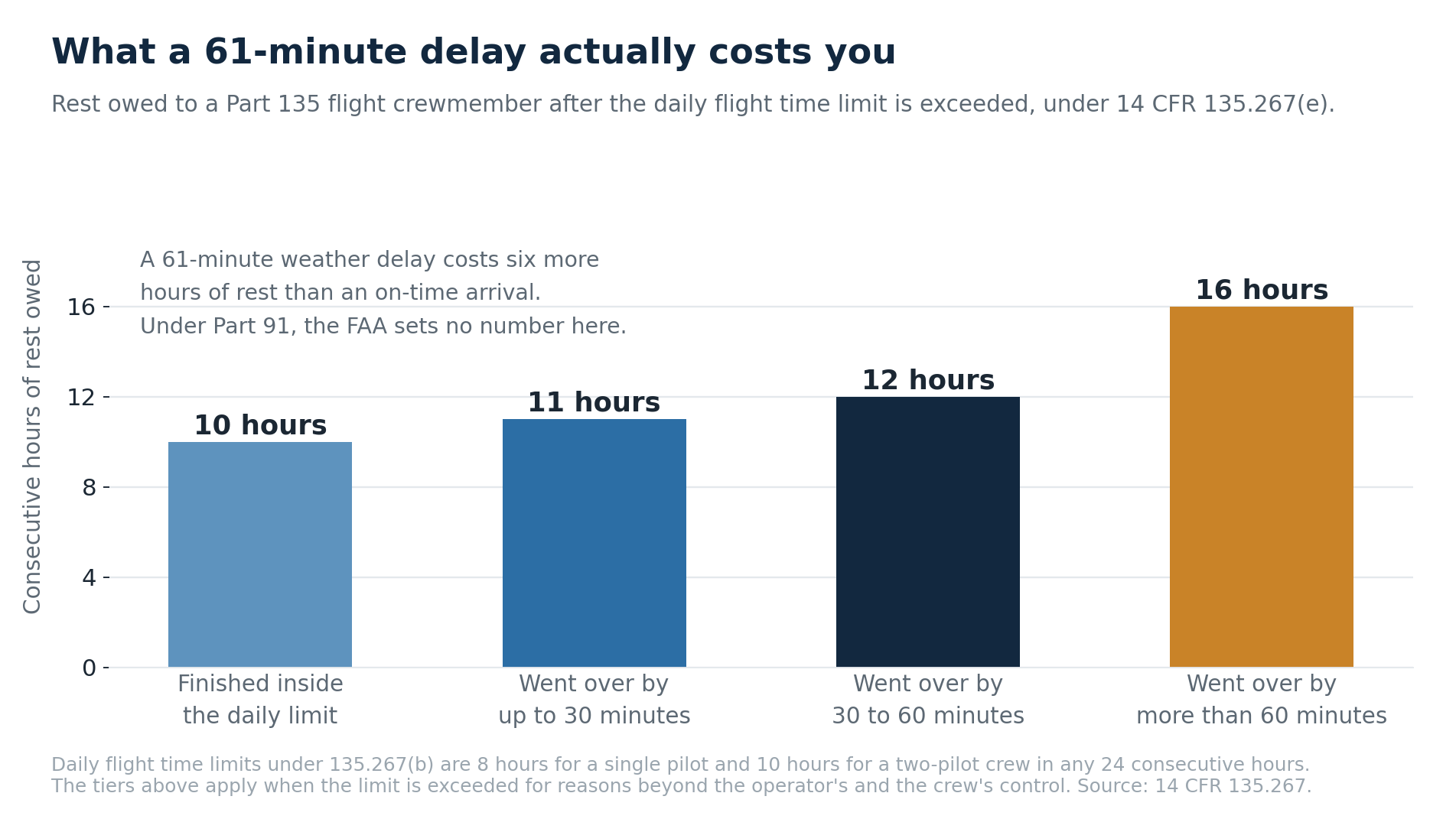
Sixty-one minutes of holding turns a 10-hour rest obligation into a 16-hour one. Your crew is now unavailable for a window that no longer fits tomorrow's schedule. That is not a paperwork problem. That is a second crew, sourced tonight. And rest means freedom from all obligation, so a crewmember sitting on call is not resting, a point NBAA has had to correct repeatedly.
Part 135 Requires You to Fill a New Seat You Didn't Have to Under Part 91
Under 135.101, no person may carry passengers IFR under Part 135 without a second in command. The only exception is 135.105, an approved autopilot in lieu of an SIC, under an authorization written into your op specs.
So a single-pilot-certificated airplane that one captain flew IFR with passengers all year under Part 91 may need two qualified pilots per trip once it flies under the certificate. Not two names on a roster. Two people who have both been through your approved training program and passed the required checks. If you are building a bench for a managed fleet, this is the multiplier that breaks the spreadsheet.
Part 135 Crew Checking Calendar Roughly Triples
Under Part 91, a captain in a turbojet or multi-pilot type needs a proficiency check under 61.58 once a year. Under Part 135, the same pilot picks up four recurring obligations: a written or oral test every 12 months under 135.293(a), a competency check in type every 12 months under 135.293(b), an instrument proficiency check every six months under 135.297 for IFR PICs, and a line check every 12 months under 135.299 over a real route segment. That last one applies to every Part 135 PIC, not only two-pilot operations, and it is the one operators most often get wrong.

The six-month IPC is what hurts scheduling. Every captain now has a cliff twice a year rather than once, and the cliffs do not line up. If nobody owns that calendar, you find out when a captain shows up for a trip he cannot legally fly.
It Is Not Only The Cockpit Requirements that Change
Under 135.107, an aircraft with more than 19 passenger seats requires a flight attendant, and that person becomes a required crewmember: tested every 12 months under 135.295, given duty and rest limits under 135.273, and folded into your approved training program. A cabin attendant you used to book by preference is now a compliance object.
Then there is 14 CFR Part 120, which requires a DOT and FAA drug and alcohol testing program for anyone performing a safety-sensitive function for your certificate. That reaches wider than most people expect: dispatchers, operations control specialists, and anyone doing aircraft maintenance, temporary and intermittent people included, and explicitly people performing those functions by contract.
Read that last clause again. The contract A&P in your hangar and the temp scheduler covering vacation are inside the program, so if your staffing vendor is not running one, or is placing people as 1099 contractors, that exposure sits on your certificate. Our post on 1099 crew misclassification risk covers what the classification test looks at. A certificate is also what usually breaks a one-person scheduling desk, which is what ONeCALL Flight Dispatch covers.
Records Become Something Somebody Can Demand
The constraint stops being "can I find a pilot" and becomes "can I find a pilot who is already legal on my certificate this week."
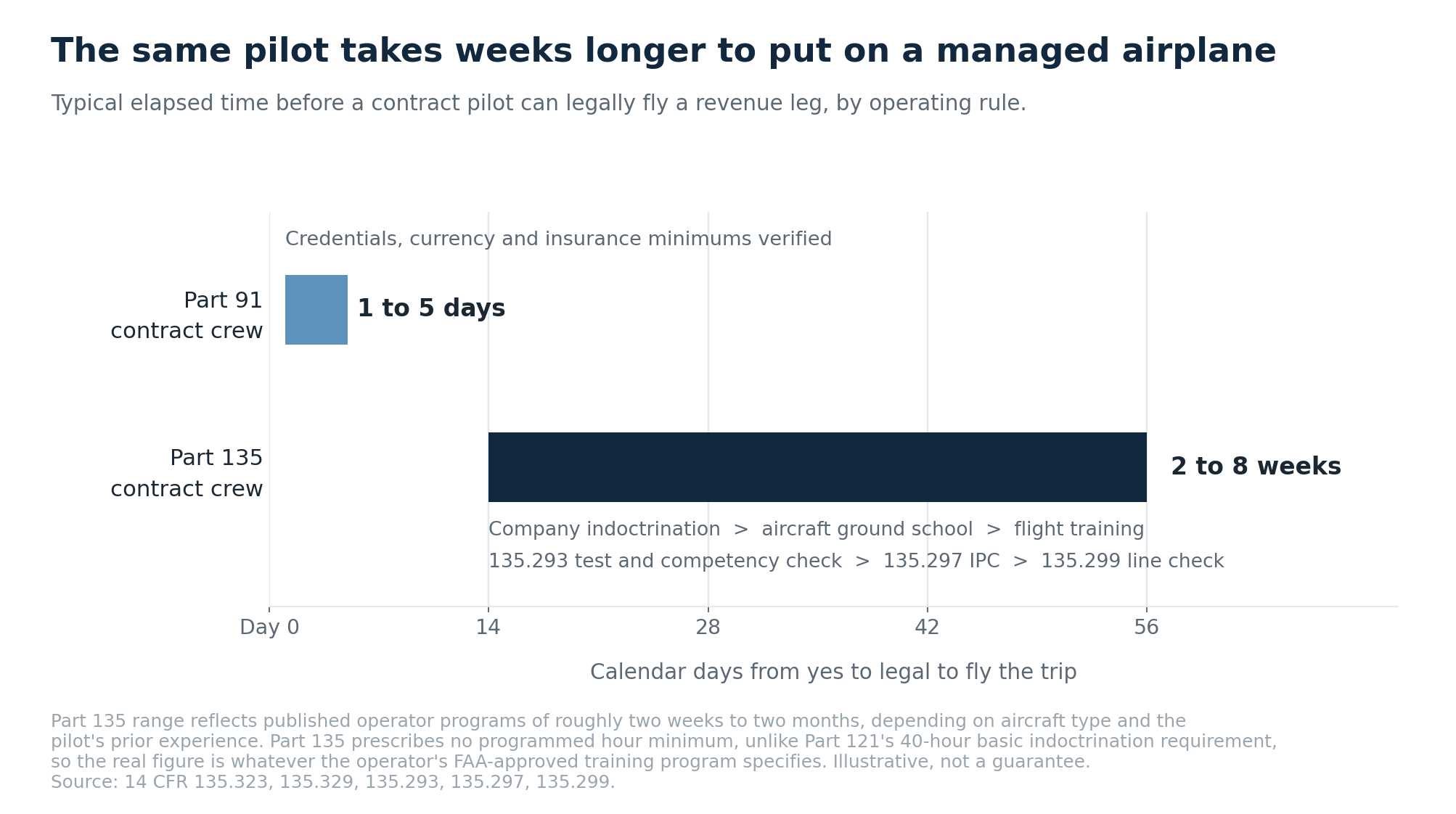
Under Part 91, a qualified contract captain can often fly inside a few days: verify the certificate and medical, confirm time in type and currency, check that they clear your policy minimums, and go. Under Part 135 they cannot fly until they have completed basic indoctrination on your certificate, ground and flight training under your approved program, the 135.293 test and competency check, the 135.297 instrument check, and the 135.299 line check. Part 135 sets no programmed hour minimum for any of it, unlike Part 121, so the real number is whatever your approved program says.
Two details make that runway harder to shorten than people expect. You cannot credit training a pilot completed under another certificate holder's program, so ten years on the same airframe for the operator across the ramp does not transfer. And while a reduced curriculum is allowed for an experienced hire, indoctrination, emergency training, and CRM hours cannot be cut. Experience shortens the middle, not the front.
Which reorders how to think about a contract bench. A pilot you onboard in October is available in October. One you decide to onboard the night a captain calls in sick is not available at all. If you run a mixed fleet, qualify everyone to the Part 135 standard by default and let the Part 91 legs inherit it. Tracking two qualification states per person is how trips get canceled.
Where the employer of record model earns its keep
Under Part 91, using contract crew is mostly a payroll and insurance question. Under Part 135, the person you bring in is inside your compliance perimeter, and their testing, screening, training records, and duty history are all things you may have to produce.
That is why contract crew placed through In-Flight Crew Connections are our W-2 employees rather than 1099 contractors. We are the employer of record, carrying the screening, Part 120 testing, records verification, workers' compensation, and global medical coverage before anyone reaches your aircraft. One employer of record across pilots, cabin attendants, and technicians means one screening standard and one audit trail, whether the leg is Part 91 or on the certificate. More details can be found on our contract staffing page and our Pilot Locator shows what we have typed by airframe. When the seat should be permanent, direct hire can run about 90 days, plus training time under a certificate.
What to ask any staffing partner before you put anyone on your certificate
Ask us these questions too. Vague answers likely mean the risk stayed with you.
- Are the crew and technicians you place your W-2 employees, or 1099 contractors?
- Do you run a Part 120 testing program covering everyone you place, including maintenance and dispatch?
- How do you confirm time in type rather than time on the badge?
- Can you produce what an FAA inspector or an ARGUS validation asks for, on the day it is asked for?
The Part That Matters At 5am
A flight department calls us at 11pm. A crew member is sick, and the aircraft needs to be wheels up at 6am. We find someone typed, current, screened, and tested, confirm duty and rest, and have them in place before the sun comes up. We have filled 99.7 percent of crew requests that way since 2002.
None of that helps at 11pm if we are not already in place, and under Part 135 that is more literally true than it used to be. A pilot who is not indoctrinated on your certificate tonight is not flying your trip tomorrow. Get the MSA signed and the bench built while the schedule is calm.
Frequently Asked Questions
What is the main staffing difference between Part 91 and Part 135?
Part 135 imposes federal flight time, duty, and rest limits on crew, requires recurring FAA tests and checks, requires an FAA-approved training program with company indoctrination before a pilot can fly, requires a DOT and FAA drug and alcohol testing program, and requires individual crew records the FAA can demand. Part 91 requires none of these for non-commercial operations. The practical result is that a Part 135 pilot takes weeks to onboard rather than days, and your available crew pool at any given moment is much smaller.
Do Part 91 operators have FAA duty and rest limits?
No. The FAA sets no flight time, duty time, or rest limits for crewmembers in non-commercial Part 91 operations. Limits come from company policy, insurance requirements, or a voluntary standard such as IS-BAO, which requires a fatigue management program under Chapter 12. Part 91 Subpart K fractional ownership programs are the exception and carry limits of their own under 91.1057 through 91.1062.
What are the Part 135 duty and rest limits for pilots?
For unscheduled operations under 14 CFR 135.267, flight time is limited to 8 hours in any 24 consecutive hours for a single pilot and 10 hours for a two-pilot crew. Duty periods are capped at 14 hours with 10 consecutive hours of rest before and after. Cumulative limits are 500 hours per calendar quarter, 800 hours across two consecutive quarters, and 1,400 hours per calendar year. Crew must also receive at least 13 rest periods of 24 consecutive hours or more each quarter.
How long does it take to onboard a contract pilot under Part 135?
Published operator programs run from about two weeks to roughly two months, depending on aircraft type and the pilot's prior experience. The pilot must complete basic indoctrination under 135.329, aircraft ground and flight training under the operator's FAA-approved program, the 135.293 written or oral test and competency check, a 135.297 instrument proficiency check to serve as IFR PIC, and a 135.299 line check. Part 135 sets no programmed hour minimum for any of this, unlike Part 121's 40-hour basic indoctrination requirement, so the actual timeline is whatever the operator's approved program specifies. Training completed under another certificate holder's program cannot be credited, and indoctrination, emergency training, and CRM hours cannot be reduced for an experienced hire.
Does Part 135 require a second pilot?
Yes, for passenger-carrying IFR operations. 14 CFR 135.101 requires a second in command whenever passengers are carried under IFR. The only exception is 135.105, which permits an approved autopilot in lieu of a second in command under an authorization written into the operator's operations specifications. A single-pilot-certificated airplane that one pilot flew IFR under Part 91 may therefore require two qualified and checked pilots once it operates under the certificate.
Are contract crew subject to Part 135 drug and alcohol testing?
Yes. 14 CFR Part 120 covers every person performing a safety-sensitive function for a Part 135 certificate holder, including flight crew, flight attendants, aircraft dispatchers, operations control specialists, and maintenance personnel. The rule applies to full-time, part-time, temporary, and intermittent workers, and explicitly to people performing those functions by contract. For 2026 the FAA random testing rates are 25 percent for drugs and 10 percent for alcohol. Contract crew placed through IFCC are our W-2 employees and are inside our program before they reach your aircraft.
When is a flight attendant required under Part 135 versus Part 91?
Under 14 CFR 135.107, an aircraft with a passenger seating configuration of more than 19 seats requires a flight attendant crewmember. Under Part 91, 91.533 requires a flight attendant when more than 19 passengers are on board a large or turbine-powered multiengine airplane. The larger difference is what follows: under Part 135 the flight attendant is a required crewmember subject to testing every 12 months under 135.295, duty and rest limits under 135.273, training under the operator's approved program, and Part 120 drug and alcohol testing.
How does an aircraft management company staff a mixed Part 91 and Part 135 fleet?
The workable approach is to qualify crew to the Part 135 standard by default and let Part 91 legs inherit that qualification, rather than tracking two qualification states per crewmember. That means a standing pool of indoctrinated and checked crew sized above current demand, one employer of record and one screening standard across pilots, cabin, and maintenance, and a single owner for the checking calendar. It costs more up front than sourcing per trip and is far cheaper than a canceled trip or an audit finding.
Can IFCC place crew for Part 135 operators and management companies, not just corporate flight departments?
Yes. Both are core to the business. IFCC's active client base includes aircraft management companies and Part 135 operators running 13 to 91 aircraft, on ongoing volume rather than one-off requests, across pilots, cabin attendants, A&P technicians, schedulers, and dispatchers, on contract and direct hire.
Adding managed aircraft or a certificate to your operation? Send us your fleet and we will show you what we have typed and current by airframe.
External Sources:
14 CFR 135.63(a)(4), 135.101, 135.105, 135.107, 135.267, 135.273, 135.293, 135.295, 135.297, 135.299, 135.323, 135.329; 91.533, 91.1057 through 91.1062; 61.58; 14 CFR Part 120
FAA random drug and alcohol testing rates for 2026, 90 FR 56249, December 5, 2025
ARGUS TRAQPak, April 2026 North America activity
NBAA guidance on Part 135 duty and rest misconceptions
WYVERN Wingman PASS, ARGUS ratings criteria, IS-BAO Chapter 12